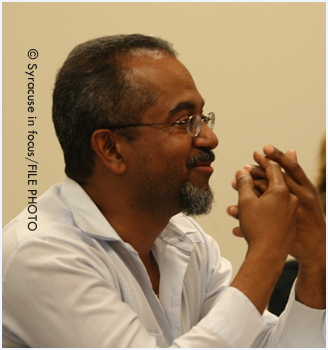
Silvio Torres-Saillant
Syracuse University professor Silvio Torres-Saillant appeared on the PBS series “Black in Latin America” last week. He talked about the early Dominican Republic nationhood and origin of blackness on the island of Hispanola.
Silvio Torres-Saillant
Syracuse University professor Silvio Torres-Saillant appeared on the PBS series “Black in Latin America” last week. He talked about the early Dominican Republic nationhood and origin of blackness on the island of Hispanola.
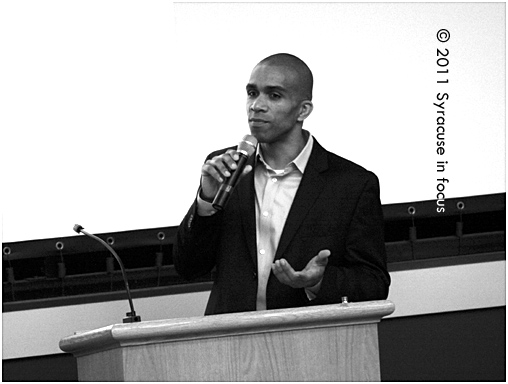
Blake Bradford, Director of Education at the Barnes Foundation
Artists and curators discussed the role of the public artist yesterday during the My America conversation series at Syracuse University.
Painter and curator Benito Huerta said it is important to advocate for diversity in gallery staff as well as curators and artists.
After talking about the exhibit that has stopped at SU (next scheduled stop: Miami), then showing some of his favorite contemporary portraits and juxtaposing them with more classic works, Infinite Mirror: Images of American Identity Curator Blake Bradford reminded the audience that we don’t have to sacrifice artistically to pursue diversity.
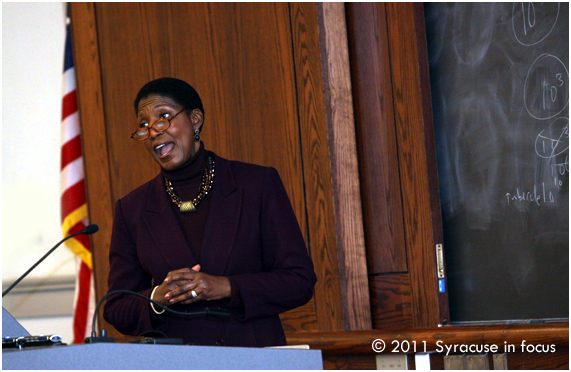
Luvenia Cowart RN, EdD, director, Genesis Health Project Network
Syracuse University Professor Luvenia Cowart, RN, EdD, discussed the strategies of the Genesis Project this afternoon at SUNY Upstate Medical Center’s Sarah Loguen Fraser Day. She discussed culturally competent principles as it relates to spreading news about healthcare and nutrition.
The Genesis Healthcare Project is a faith-based initiative that seeks to make black men good healthcare consumers by engaging them at community locations such as barbershops and churches.
Genesis received a NIH grant in 2009.
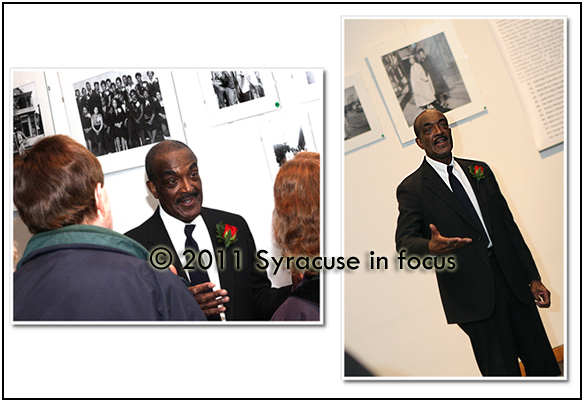
Richard Breland at Syracuse University discussing his photo collection
Photographer, historian, activist and all-around nice guy Richard Breland attended a public event and talked about his life in pictures tonight. Much of his archive features pictures of Syracuse’s old 15th Ward. Breland’s work, which will be displayed on campus until March, is the latest public showing for the Black Syracuse Project coordinated by Syracuse University.
Al Balk, the first professor I met at the S.I. Newhouse School of Public Communication, passed away last week. He was the founding editor of World Press Review.
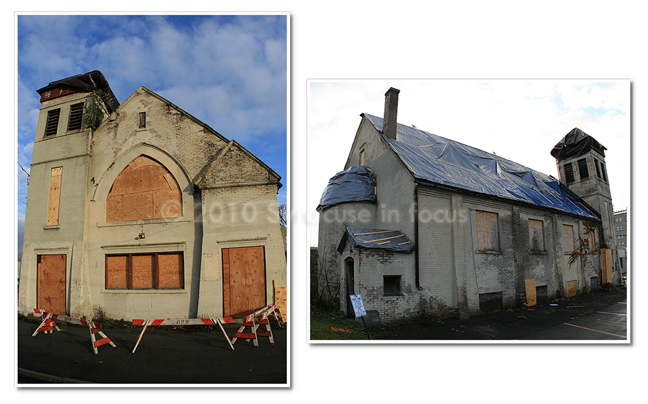
Former AME Church, E. Fayette Street
The 100-year old, former People’s AME Church building, located at East Fayette Street, will be preserved as a Historic Landmark.
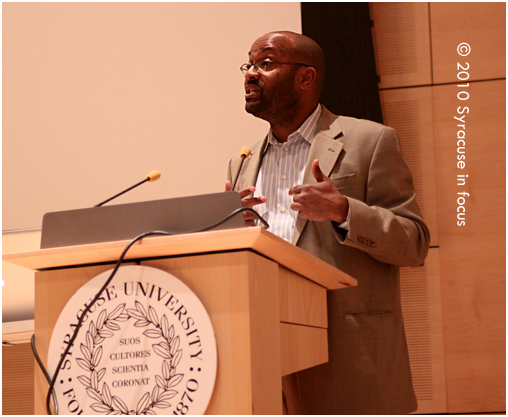
Jabari Asim at Syracuse University
Journalist Jabari Asim, editor of The Crisis, spoke this week at Syracuse University’s S.I. Newhouse School of Public Communication. He said The Crisis has a legacy of fighting against “erase and replace syndrome” and correcting historic inaccuracies about African Americans.
The Crisis, the official publication of the NAACP, was founded in 1910 by W.E.B. DuBois. The first issue was published in November of that year, and the circulation was 1000. Today the readership is over 200,000.
Asim said his current goal is to keep the magazine relevant and cultivate a younger audience (average age of a reader is now 63).
The Syracuse University School of Architecture (SoA) celebrated city life this week at the Formerly Urban (Projecting Rust Belt Futures) Symposium. Speakers from Syracuse, Cleveland, Los Angeles, Phoenix, Toronto and Paris discussed depopulation, prairie urbanism, redefining district identities, and new structures to activate urban life.
SoA Dean Mark Robbins said architects should harness the drive of commerce for the betterment of our cities and create incentives to do better (design, planning) work.
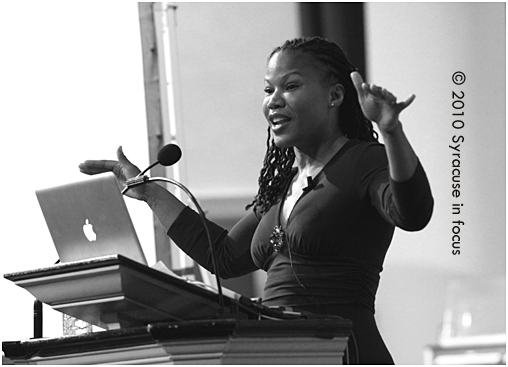
Majora Carter, environmental justice advocate and green collar entrepreneur
Environmental justice advocate and green collar entrepreneur Majora Carter visited Syracuse yesterday and spoke for the University lecture series at Hendricks Chapel. She detailed how cities can turn financial disinvestment and environmental degradation into movements for equality and recognition of environmental assets.
Carter had really good things to say about Syracuse, especially the Near West Side Initiative. Her talk wasn’t very long so it’s understandable that she didn’t address Onondaga Creek or the Syracuse University Steam Station.
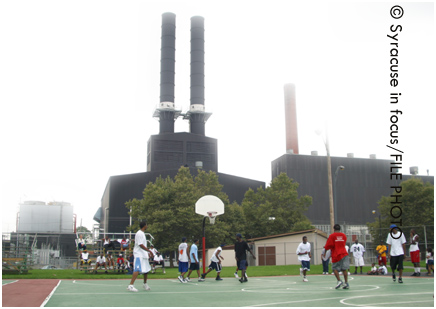
Wilson Park
I first heard about Carter after her TED Talk a few years ago.
Her organization (Majoracartergroup.com) now promotes micro agribusiness development through green roofs and urban greenhouses.
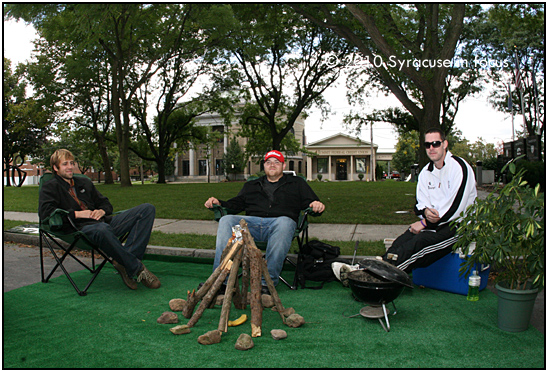
ESF students Nick Watkins, Brendan Beeke and Thaddeus Holland set up in a metered parking space along the Connective Corridor on East Genesee Street today.
Cities around the world today celebrated Park(ing) Day, an event to advocate for more green spaces in urban areas.
Several neighborhoods in downtown Syracuse participated, including the Midtown section (pictured above).
The event was started in San Francisco in 2005.